How many businesses are in my area? Sizing a local market
By Doug Nielsen, Product Manager · Updated · first published
To count the businesses in your area, search Google Maps one ZIP code at a time and dedupe the results on Google's place ID. One search won't do: the results feed stops at roughly 100–120 places, however many exist.
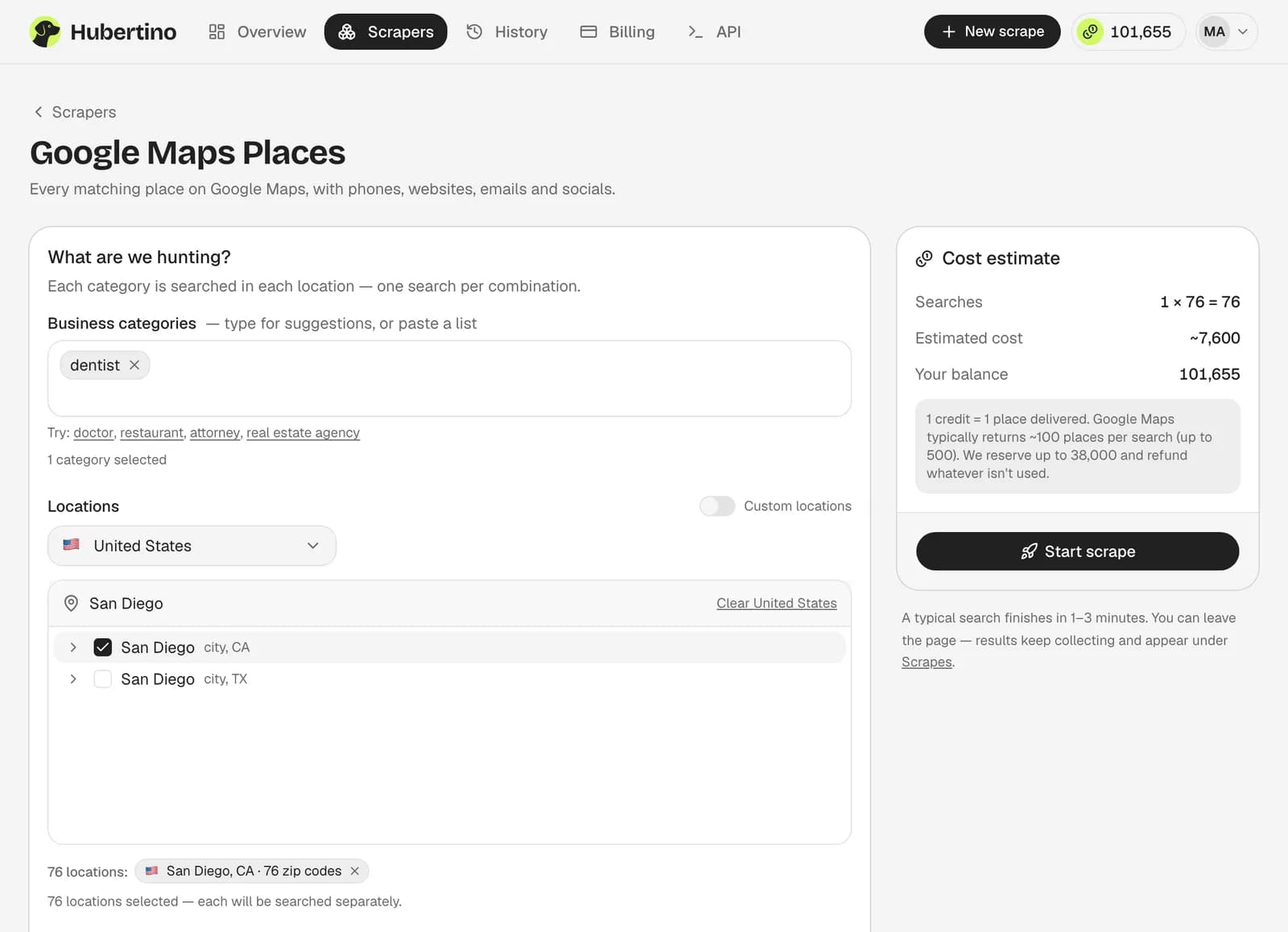
In our Google Maps scraper, ticking a city queues every one of its ZIP codes, so the whole count takes one job.
Key takeaways
- Pin down the exact category before you count.
- The splits, not the total, tell you which offer to lead with.
- Quote the result as “listed on Google Maps”, not “registered businesses”.
On this page5
Why the obvious methods undercount
A single map search is capped, directories are stale, and government registries count legal entities, including dormant ones, while missing branches trading under one registration. Google Maps is the most current census of businesses actually open, because owners maintain their own listings.
The method: count ZIP code by ZIP code
Define the category precisely
“Restaurant” and “Italian restaurant” give very different counts; either can be right, so write down which you mean.Split the geography into ZIP codes
Each ZIP code gets its own search, usually under the feed cap. Hubertino's location picker does the split; the ZIP-code guide explains it.Dedupe on place ID
Neighboring ZIP-code searches overlap; Google's place ID collapses them reliably (see place IDs and CIDs).Segment the count
Split by review count (zero-review businesses may be barely trading), website or none, ratings below 4.0, neighborhood, and chain versus independent from the domain column. The splits, not the total, tell you which offer to lead with.
Get the whole list in one job
- 100 free credits
- No card required
Reading the number you get
The number counts businesses listed and findable on Google Maps in this category and area: a real population, and the one your competitors sell to. The export doubles as your prospect list, which no market-size report gives you.
Watch out
Sanity-check the total
Common questions
Does this count businesses that don't have a Maps listing?
How much does counting a city cost?
Written by
Doug Nielsen, Product Manager
Doug works on Hubertino; the guides on this site are published under his name. Last updated .