Zip-code scraping: why one city search misses most listings
By Doug Nielsen, Product Manager · Updated · first published
One Google Maps search stops at roughly 100–120 places, so “dentist Chicago” shows only the top-ranked slice of the city's 3,400 or so dentists (our rough estimate). Splitting the city into one search per ZIP code closes the gap.
One Hubertino scrape runs up to 2,000 ZIP-code searches; our Google Maps data extractor page lists the other job limits.
Key takeaways
- The cap is per search: split the area until each search sits below it.
- Neighboring ZIP searches overlap: dedupe the export on place ID, never on name.
- Past the first hundred are smaller, newer businesses: for most service offers, the better leads.
On this page6
What the cap is
The cap is Google's: its results feed stops paginating, and the official Places API traditionally stops sooner, at 60 across paged requests. The cap applies per search, not per area, so each ZIP search gets its own. Results are ranked by prominence, proximity and relevance, so a truncated search isn't a random sample: it's the most established businesses, missing smaller, newer ones that, for most service offers, are the better leads.
Doing it in practice
Pick small enough areas
ZIP or postal codes work in most countries. In a dense core a common category can still hit the cap within one ZIP: split by neighborhood or narrow the category.Run one search per code
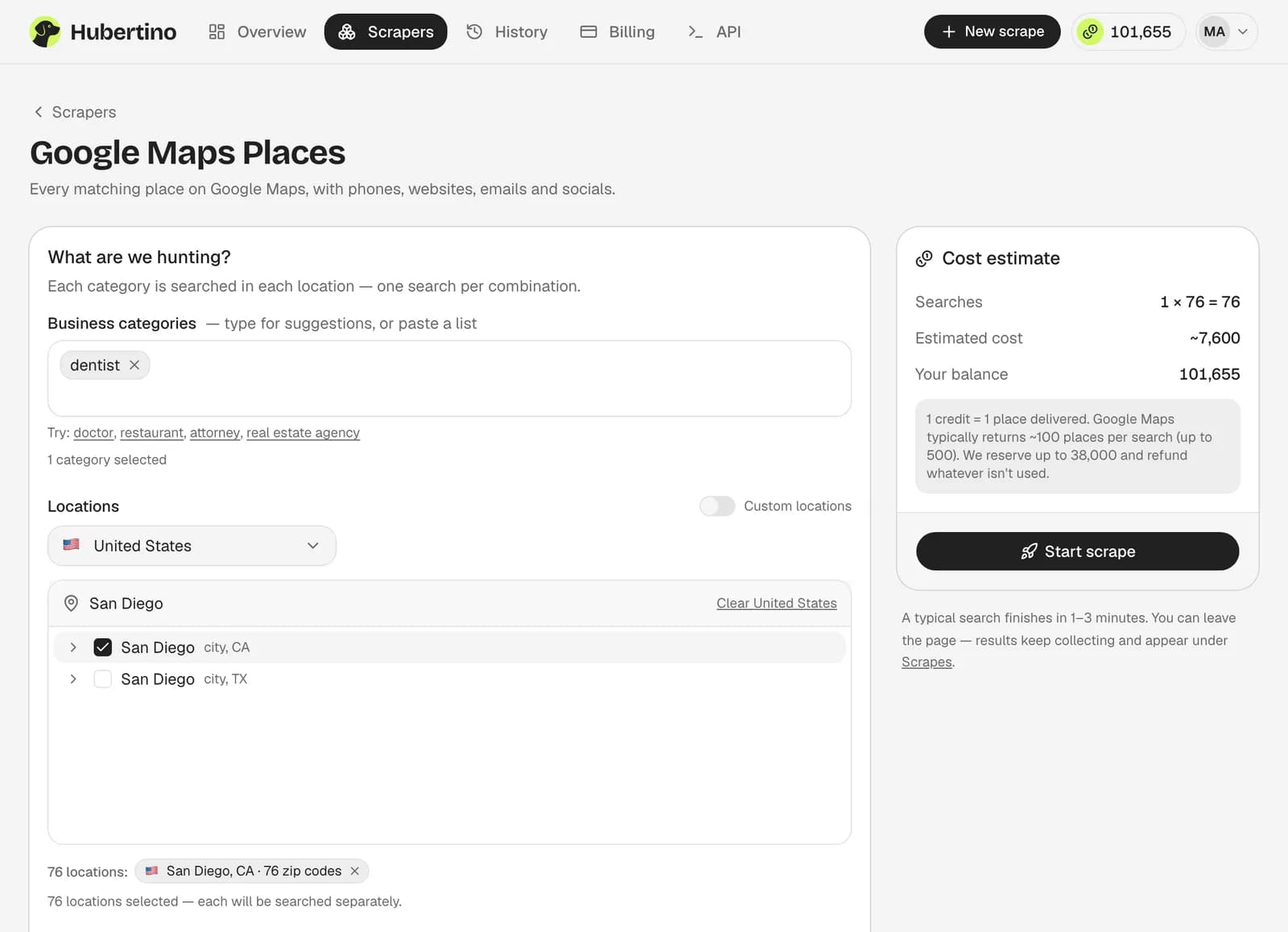
Hubertino's location picker expands a city into its ZIP codes and searches each separately, streaming into one table. By hand, you'd run a ZIP list one search at a time.Dedupe on place ID
Results don't follow ZIP boundaries exactly, so neighboring searches overlap. Deduping on place ID collapses them exactly; deduping on name merges different businesses and misses real duplicates.
Tip
Sanity-check the total
Get the whole list in one job
- 100 free credits
- No card required
What it changes downstream
Market sizing stops being wrong: counting businesses in an area depends on it. Territories get real per-ZIP counts instead of a truncated top 100, and site-selection saturation maps become comparable instead of all pinned at the same ceiling.
What complete coverage costs
You pay per business delivered, so a full-market list is priced by the market's real size, not a misleading hundred rows. Credits reserved for results that never arrive refund automatically.
Common questions
Does this work outside the US?
Won't I pay for the same business twice across overlapping ZIPs?
How many ZIP codes does a typical city have?
Written by
Doug Nielsen, Product Manager
Doug works on Hubertino; the guides on this site are published under his name. Last updated .