A Google Places API alternative for building lead lists

By Doug Nielsen, Product Manager · Updated · first published

The official Places API is the right tool for a lot of things — and building an outreach list generally isn't one of them. It's designed to power place features inside your own product: a search box, a store locator, a map. Used that way it's excellent. Used as a lead-list source it runs into three walls: the fields you want aren't there, results per search are capped, and the terms restrict storing what you pull.

Pick Hubertino if you…

  • • need emails and social profiles, which the official API simply does not return
  • • need deep coverage of a whole metro, not the first page or two of results
  • • want a spreadsheet you can keep, sort and hand to a sales rep
  • • don't want to build and maintain API plumbing and billing just to get a list

Use the Places API if you…

  • • are building a product feature — autocomplete, a store locator, a map view
  • • need live, always-current place data rendered alongside Google attribution
  • • want the official, fully sanctioned integration path with Google support
Side by side

the Google Places API descriptions reflect public information as of July 2026 and haven't been re-checked since; "Not verified by us" marks features we didn't check. See its site for current details.

Hubertinothe Google Places API
Business emails Yes No
Facebook / Instagram / LinkedIn profiles Yes No
Results per searchWhole metros via zip-code expansionCapped per query (about 60 for text search)
Keeping the data in a spreadsheetYes — XLSX / CSV, yours to keepRestricted by the Maps Platform terms
SetupSign up and searchCloud project, API keys, billing, code
Pricing model1 credit = 1 business deliveredPer-request billing by SKU and field set
ReviewsFull review scraperPartly
Best forProspect lists and outreachProduct features and live place lookups

Weighing up cost across tools? See Outscraper vs Scrap.io vs Apify pricing for the cost per 1,000 businesses on each, worked through at the same volumes.

What using Hubertino looks like

Here's how Hubertino's Google Maps scraper works:

  1. 1. Describe the hunt. Type a business category (“dentist”, “roofing contractor”, anything) and pick locations — whole countries, states, cities or zip codes from the built-in picker.
  2. 2. Watch it fill. Results stream into a live table as they're found: phone, website, then the email and socials dug from each business's site.
  3. 3. Export and go. Download XLSX/CSV — one business per row — or pull it via the API. You're only charged for what was actually delivered.
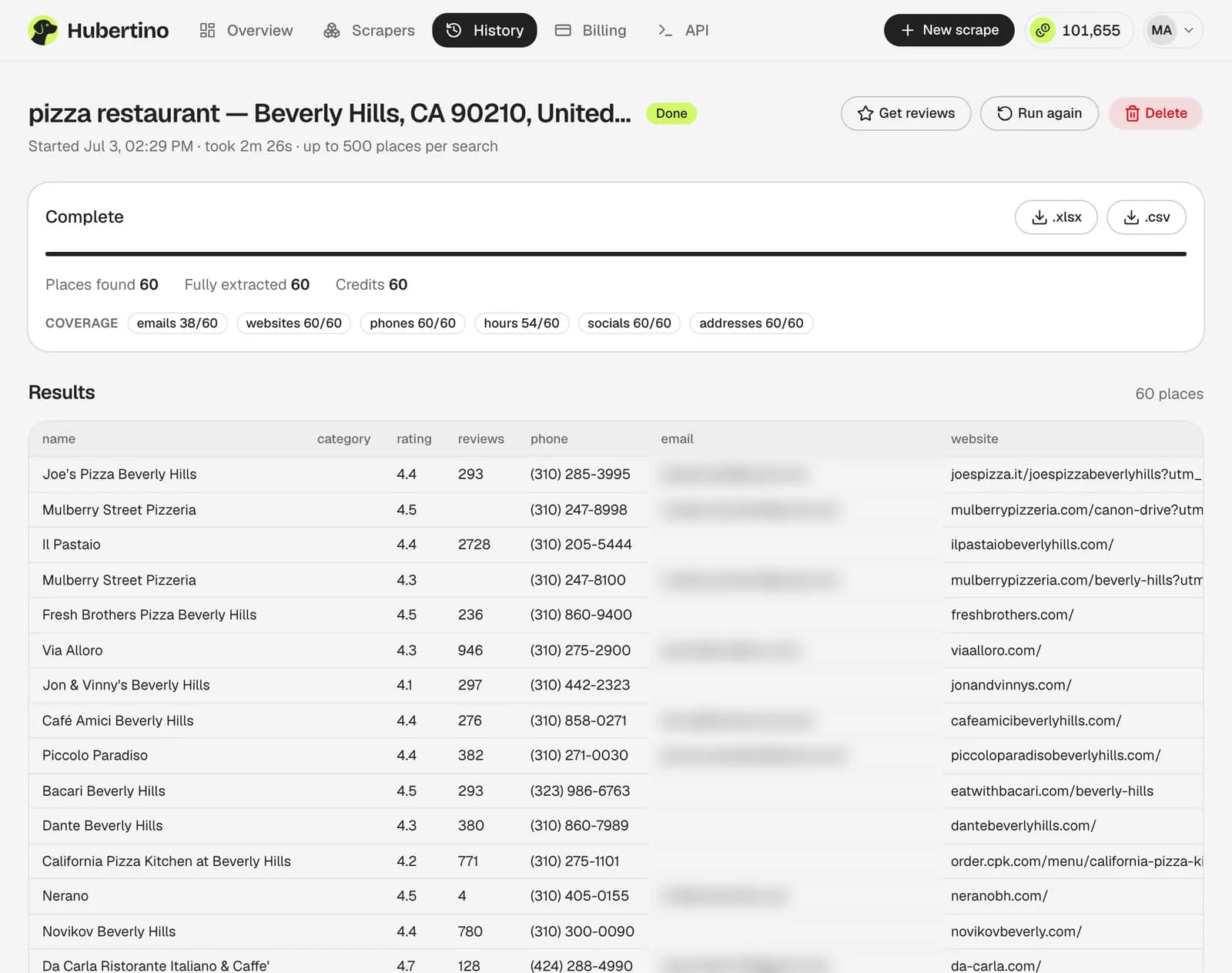
A finished Hubertino scrape of 60 pizza restaurants in Beverly Hills: coverage counts per field, a results table with phones and websites, and .xlsx and .csv download buttons (emails blurred)
A finished Hubertino run: 60 pizza restaurants in Beverly Hills, with coverage counts for every field and one-click .xlsx or .csv export. (Emails blurred here.)
Try it free — 100 credits

Questions

Can I just use the Google Places API to build a lead list?

Technically you can call it, but it's a poor fit. It returns no email addresses and no social profiles, a single text search returns a capped number of results (around 60), and the Google Maps Platform terms restrict scraping, storing and caching place content outside the service. For a list you intend to keep and email, that's three problems at once.

So when should I use the official API?

Whenever place data is a feature of your product: address autocomplete, a store locator, showing nearby businesses on a Google map. That's exactly what it's designed and licensed for, and nothing else does it as well.

What does the Places API cost for a lead list?

Asking for phone and website bills a Text Search request as Text Search Enterprise: $35 per 1,000 requests after 1,000 free a month, less above 100,000. A request returns at most 20 places, so that's $1.75 per 1,000 places on full pages, or $20 per 1,000 through Place Details, with no emails either way (Google's price list, checked September 2026). Our Places API cost calculator prices your own volume.

How does Hubertino get more results than the API returns?

By splitting the geography instead of asking one big question. The location picker expands a city into its zip codes and runs your category across each one, so you get past the per-search ceiling that limits any single query.

Does Hubertino return the same fields as the API?

It returns the listing fields you'd expect — name, address, phone, website, category, rating, review count, hours, coordinates — plus the ones the API doesn't have: emails and social profiles crawled from each business's own website, across a 38-column export.

Does Hubertino have an API?

Yes — a REST API with an OpenAPI spec (create a scrape, poll status, fetch results, export files; Bearer-key auth), on every plan, plus free n8n templates that send leads to Google Sheets or HubSpot.

the Google Places API is a trademark of its owner and isn't affiliated with Hubertino. This page is our honest take on when each tool fits — see also our comparison of Google Maps scrapers.

More comparisons

Try it on your own niche

Start free with 100 credits — enough for a real lead list. No card required.

Start free with 100 credits